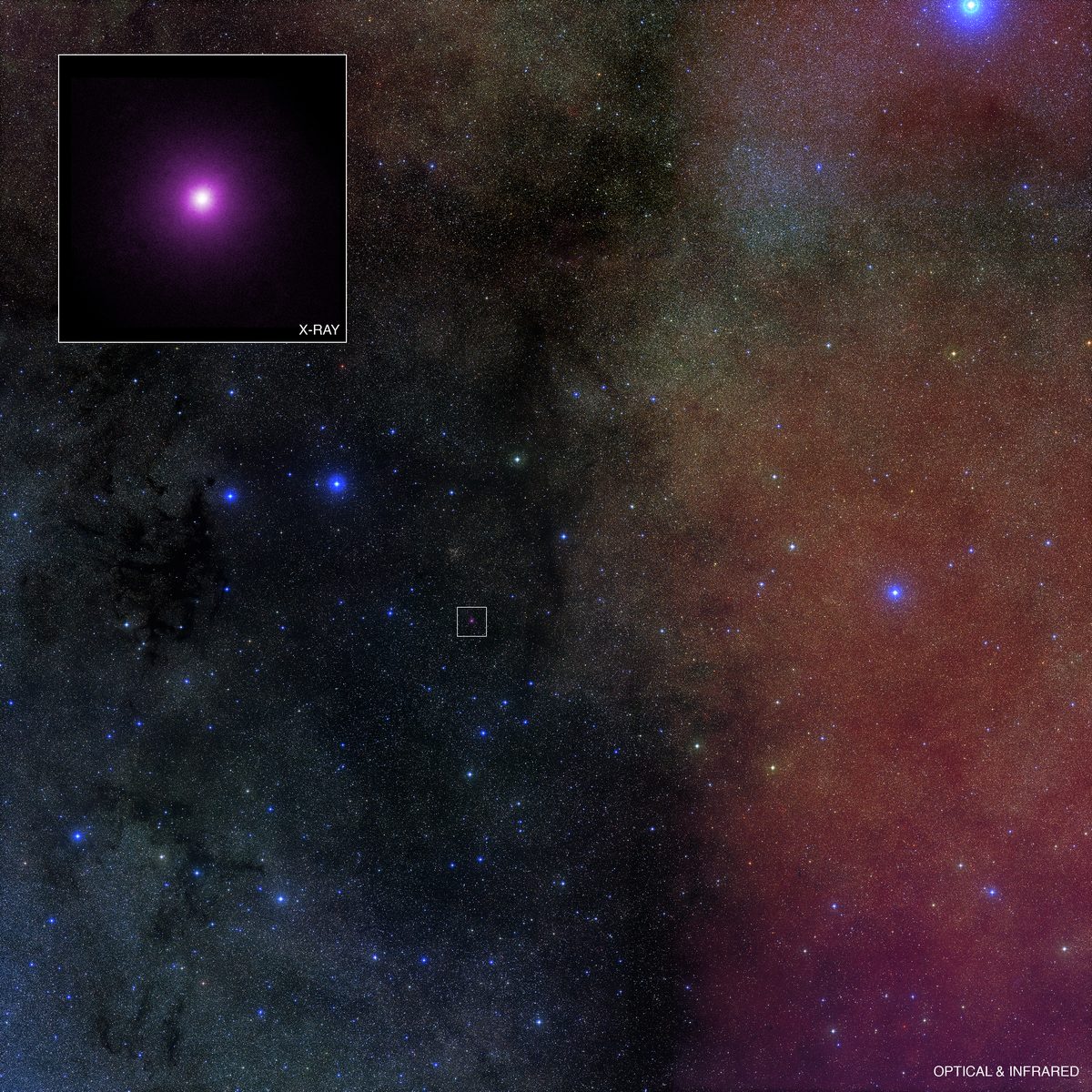
GRS 1915+105, a black hole with a heartbeat
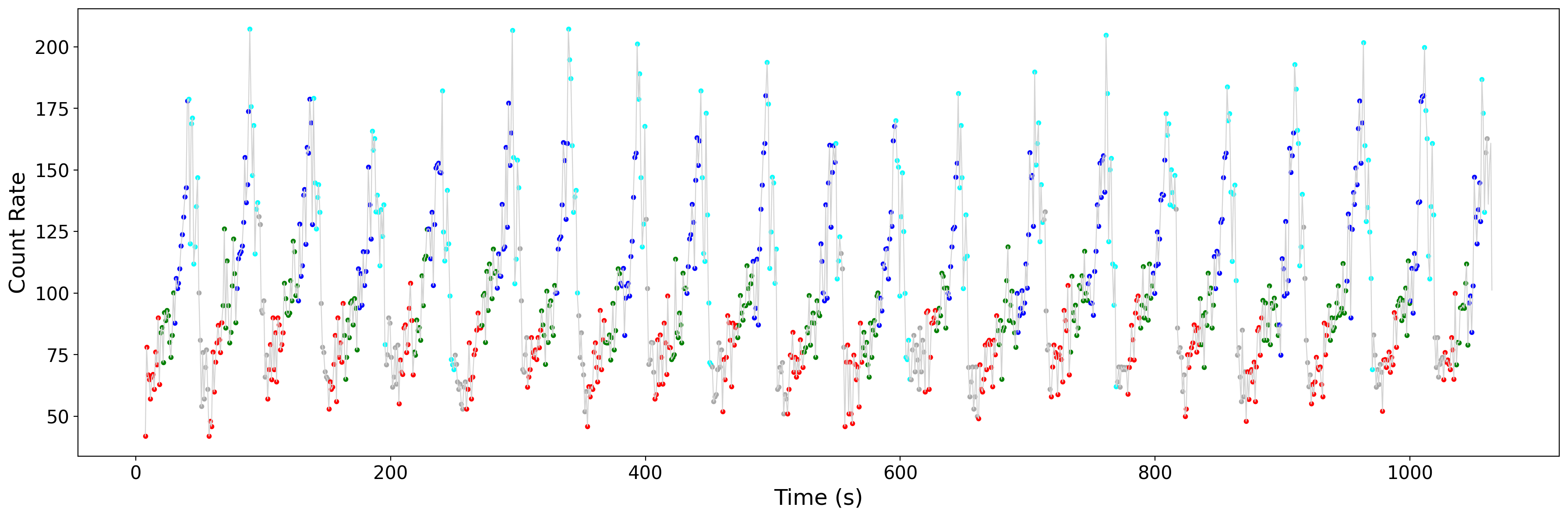
GRS 1915+105 is a black hole that flares every 50 to 100 seconds. Over and over.
So I cut every cycle into five pieces, three going up and two coming down, and fit each piece separately. With just the soft X-rays it looked like the disk was heating up and cooling down every single cycle. Then we added AstroSat, whose SXT and LAXPC reach up to 30 keV, and the disk could just sit at one temperature the whole time, which kind of ruined that.
The corona is the hot gas close to the black hole, and it's what makes most of the hard X-rays. In these data the disk temperature can stay the same through the whole cycle, and most of the change shows up in the corona.
The longer story
I used 24 Swift observations and 2 from AstroSat. They weren't taken at the same time, so they show the same kind of heartbeat on different days.
Cutting the cycle into more pieces would show finer changes, but each piece would have fewer photons in it, so five was where I settled.
Swift only covers 1 to 10 keV. AstroSat's two instruments together go from 0.8 to 30 keV, and those extra hard X-rays are what pin down the corona.
To check the disk properly, we fit all five AstroSat pieces together, once letting the disk temperature change between pieces and once forcing it to stay the same. The version with one temperature still fit fine.
Forcing the whole disk to stay fixed, temperature and size together, did not fit. So something about the disk still changes during the cycle, just most likely not its temperature.
That size is an apparent size though. It comes out of the model and depends on things like the distance and the angle we see the disk at, so it doesn't mean the inner edge of the disk is actually moving in and out.
For astronomers: data, fits, caveats
- Source
- GRS 1915+105, ρ-class, period ≈50–100 s. Adopted d ≈ 8.6 kpc, M = 12.4 ± 2.0 M☉ (Reid et al. 2014).
- Swift XRT
- 24 WT-mode ρ-class observations, May 2014 to April 2015 (MJD 56778–57142, Table 1), selected from 702 archival observations. Fit over 1–10 keV with
tbabs*(diskbb+bremss+powerlaw). - AstroSat
- 2 ρ-class observations (MJD 57856–57857). LAXPC 3–30 keV (9378 s, 15269 s), SXT 0.8–7 keV (3604 s, 7898 s). Joint fit with
tbabs*const*(diskbb+nthcomp). - Phases
- Each trough-to-peak interval split into three equal phases (1–3), each peak-to-trough interval into two (4–5). Matching phases stacked across cycles.
- Swift fits
- Table 2: Tin = 1.53–1.91 keV and apparent Rin = 18.1–37.6 km across phases; χ²ν = 1.09–1.20. Errors 90%.
- AstroSat fits
- Every parameter free per phase (Table 2): Tin = 1.24–1.31 keV, Γ = 1.77–2.01, kTe from 6.2+0.6−0.5 keV (Phase 1) to 14.5+10.3−3.4 keV (Phase 4); χ²ν = 0.84–1.10.
- Disk test
- Tin tied across all five phases (Table 3): Tin = 1.275 ± 0.020 keV, Δχ² = +4.3 for 4 added constraints, χ²ν = 1.003 for 1881 dof. Tin and normalization both tied: Δχ² = +175.9, rejected. Tied-Tin apparent Rin spans 18.1 ± 0.7 to 21.9 ± 0.7 km (≈20%), and kTe rises from 6.5+0.5−0.4 keV (Phase 1) to 13.8+8.7−3.1 keV (Phase 5).
- Timing
- Positive lags of 5–8 s at the heartbeat frequency (≈0.01–0.02 Hz) between the 1–3 keV reference and the 0.3–1 and 3–10 keV bands, near zero above ≈0.1 Hz. Counter-clockwise loop in the XRT hardness–intensity diagram.
The five phases are bins, and the source keeps changing inside each one, so they aren't five fixed states. SXT covers less time than LAXPC, so their phase-combined spectra include partly different cycles, and a cross-normalization constant fixes a mean offset but not that. The apparent inner radius depends on distance, inclination and the colour correction. The timing and spectra describe the sequence through a cycle, but they don't tell you what triggers the heartbeat.
Paper and figures
Akbari, K., Patel, C., Bhattacharya, S., Bhattacharyya, S., & Choudhury, M. “Probing heartbeat oscillations from the black hole X-ray binary GRS 1915+105 using spectral-timing analysis.” The Astrophysical Journal 1007, 64 (2026).